


Start here
Find your score
from fu and han.
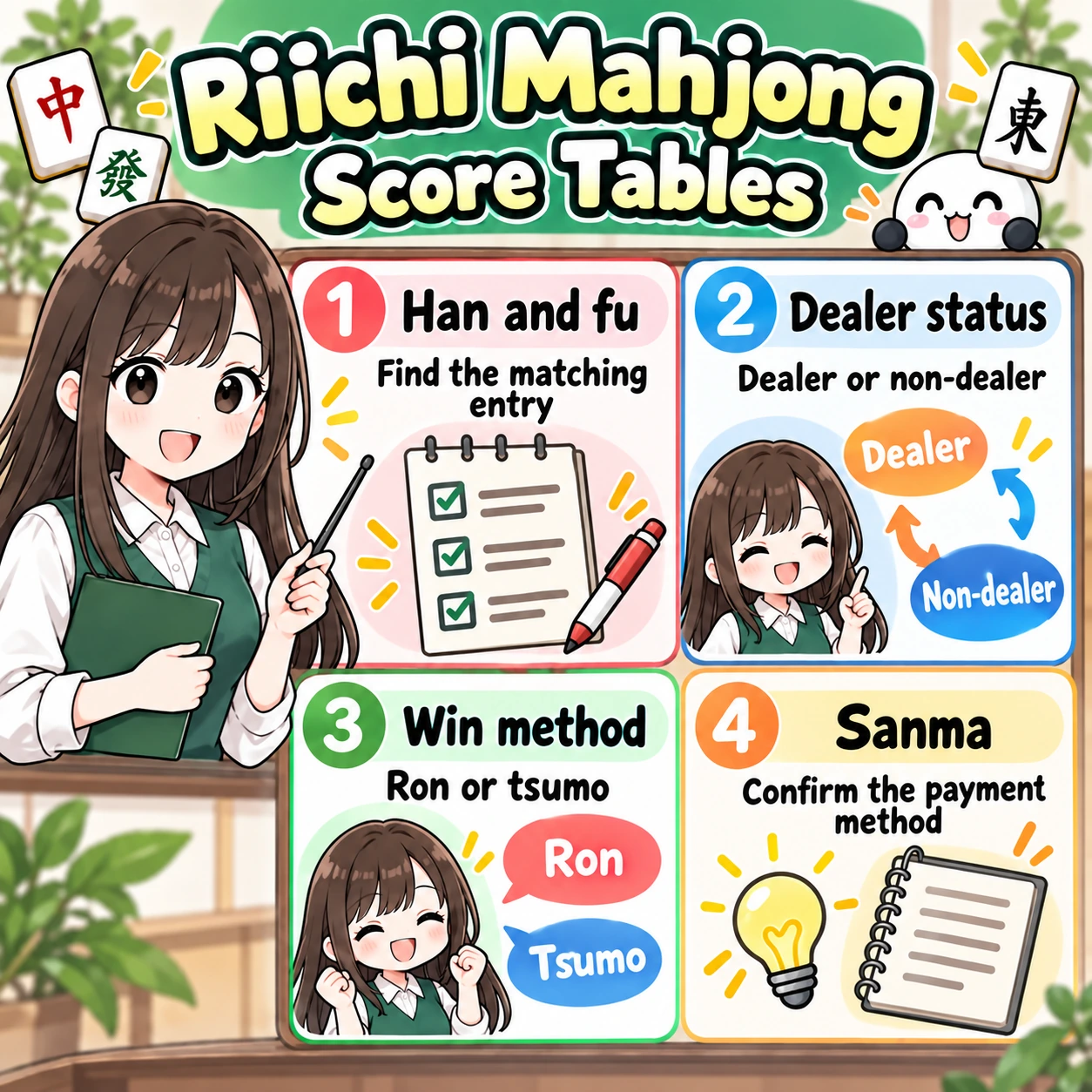
First confirm dealer status and ron or tsumo. Then read the cell where your fu row meets your han column.
Three things to remember
- Dealer or non-dealer?The same hand has different payment values
- Check fu and hanCount from the yaku and winning shape
- Ron or tsumo?In sanma, also check the payment method
 Enlarge the illustration ↗
1. How to read the tables
Reading a scoring table
- Check whether the winner is the dealer or a non-dealer.
- Count the hand’s fu and han.
- In the relevant table, find the intersection of the fu row and han column.
- For ron, read the discarder’s payment. For tsumo, read each opponent’s payment.
Non-dealer tsumo is shown as “non-dealer payment / dealer payment.” At 30 fu, 3 han, “1,000 / 2,000” means each of the two non-dealers pays 1,000 and the dealer pays 2,000. For dealer tsumo, all three opponents pay equally, shown as “2,000 each,” for example.
The tables exclude honba and riichi deposits. A common four-player rule adds 300 points per honba on ron or 100 from each opponent on tsumo. Follow your table’s settings if the additions differ.
2. Four-player scoring tables
Four-player non-dealer scores
Each cell shows ron above tsumo. Tsumo payments are listed as non-dealer / dealer. A 20-fu hand is pinfu tsumo, so its ron entry is shown as “—.”
| Fu | 1 han | 2 han | 3 han | 4 han |
|---|---|---|---|---|
| 20 fu | ― | Ron ―Tsumo 400 / 700 | Ron ―Tsumo 700 / 1,300 | Ron ―Tsumo 1,300 / 2,600 |
| 25 fu | ― | Ron 1,600Tsumo 400 / 800 | Ron 3,200Tsumo 800 / 1,600 | Ron 6,400Tsumo 1,600 / 3,200 |
| 30 fu | Ron 1,000Tsumo 300 / 500 | Ron 2,000Tsumo 500 / 1,000 | Ron 3,900Tsumo 1,000 / 2,000 | Ron 7,700Tsumo 2,000 / 3,900 |
| 40 fu | Ron 1,300Tsumo 400 / 700 | Ron 2,600Tsumo 700 / 1,300 | Ron 5,200Tsumo 1,300 / 2,600 | Mangan |
| 50 fu | Ron 1,600Tsumo 400 / 800 | Ron 3,200Tsumo 800 / 1,600 | Ron 6,400Tsumo 1,600 / 3,200 | Mangan |
| 60 fu | Ron 2,000Tsumo 500 / 1,000 | Ron 3,900Tsumo 1,000 / 2,000 | Ron 7,700Tsumo 2,000 / 3,900 | Mangan |
| 70 fu | Ron 2,300Tsumo 600 / 1,200 | Ron 4,500Tsumo 1,200 / 2,300 | Mangan | Mangan |
| 80 fu | Ron 2,600Tsumo 700 / 1,300 | Ron 5,200Tsumo 1,300 / 2,600 | Mangan | Mangan |
| 90 fu | Ron 2,900Tsumo 800 / 1,500 | Ron 5,800Tsumo 1,500 / 2,900 | Mangan | Mangan |
| 100 fu | Ron 3,200Tsumo 800 / 1,600 | Ron 6,400Tsumo 1,600 / 3,200 | Mangan | Mangan |
| 110 fu | Ron 3,600Tsumo 900 / 1,800 | Ron 7,100Tsumo 1,800 / 3,600 | Mangan | Mangan |
Four-player dealer scores
When the dealer wins by tsumo, all three non-dealers pay equally. “Each” is the amount paid by one opponent.
| Fu | 1 han | 2 han | 3 han | 4 han |
|---|---|---|---|---|
| 20 fu | ― | Ron ―Tsumo 700 each | Ron ―Tsumo 1,300 each | Ron ―Tsumo 2,600 each |
| 25 fu | ― | Ron 2,400Tsumo 800 each | Ron 4,800Tsumo 1,600 each | Ron 9,600Tsumo 3,200 each |
| 30 fu | Ron 1,500Tsumo 500 each | Ron 2,900Tsumo 1,000 each | Ron 5,800Tsumo 2,000 each | Ron 11,600Tsumo 3,900 each |
| 40 fu | Ron 2,000Tsumo 700 each | Ron 3,900Tsumo 1,300 each | Ron 7,700Tsumo 2,600 each | Mangan |
| 50 fu | Ron 2,400Tsumo 800 each | Ron 4,800Tsumo 1,600 each | Ron 9,600Tsumo 3,200 each | Mangan |
| 60 fu | Ron 2,900Tsumo 1,000 each | Ron 5,800Tsumo 2,000 each | Ron 11,600Tsumo 3,900 each | Mangan |
| 70 fu | Ron 3,400Tsumo 1,200 each | Ron 6,800Tsumo 2,300 each | Mangan | Mangan |
| 80 fu | Ron 3,900Tsumo 1,300 each | Ron 7,700Tsumo 2,600 each | Mangan | Mangan |
| 90 fu | Ron 4,400Tsumo 1,500 each | Ron 8,700Tsumo 2,900 each | Mangan | Mangan |
| 100 fu | Ron 4,800Tsumo 1,600 each | Ron 9,600Tsumo 3,200 each | Mangan | Mangan |
| 110 fu | Ron 5,300Tsumo 1,800 each | Ron 10,600Tsumo 3,600 each | Mangan | Mangan |
Limit hands: mangan through yakuman
Hands with 5 han or more, or enough basic points to reach mangan, use the following scores regardless of fu.
| Limit | Han threshold | Non-dealer ron | Non-dealer tsumo Non-dealer / dealer | Dealer ron | Dealer tsumo Each opponent |
|---|---|---|---|---|---|
| Mangan | 5 han, or the mangan basic-point threshold | 8,000 | 2,000/4,000 | 12,000 | 4,000 |
| Haneman | 6–7 han | 12,000 | 3,000/6,000 | 18,000 | 6,000 |
| Baiman | 8–10 han | 16,000 | 4,000/8,000 | 24,000 | 8,000 |
| Sanbaiman | 11–12 han | 24,000 | 6,000/12,000 | 36,000 | 12,000 |
| Yakuman | A yakuman yaku, or 13+ han if counted yakuman is allowed | 32,000 | 8,000/16,000 | 48,000 | 16,000 |
Some rules cap 13 han or more at sanbaiman instead of allowing counted yakuman. Record this and any double-yakuman rules on your rules sheet before playing.
Try MemoJong: Enter a hand to check the table’s score →
3. Three-player scoring tables
Three-player mahjong scores
Sanma ron scores use the same calculation as four-player mahjong. Tsumo depends on how the missing North player’s payment is handled. The tables show both tsumo loss and a method that shares North’s payment between the remaining two opponents, as used by SEGA MJ.
With tsumo loss
The two opponents pay the same individual amounts as in a four-player game. The missing North player’s payment is not replaced, so the winner receives less than the ron value. For a dealer’s mangan tsumo, the two non-dealers pay 4,000 each, giving the winner 8,000 in total.
| Fu | 1 han | 2 han | 3 han | 4 han |
|---|---|---|---|---|
| 20 fu | ― | Non-dealer: 400 / 700 Dealer: 700 | Non-dealer: 700 / 1,300 Dealer: 1,300 | Non-dealer: 1,300 / 2,600 Dealer: 2,600 |
| 25 fu | ― | Non-dealer: 400 / 800 Dealer: 800 | Non-dealer: 800 / 1,600 Dealer: 1,600 | Non-dealer: 1,600 / 3,200 Dealer: 3,200 |
| 30 fu | Non-dealer: 300 / 500 Dealer: 500 | Non-dealer: 500 / 1,000 Dealer: 1,000 | Non-dealer: 1,000 / 2,000 Dealer: 2,000 | Non-dealer: 2,000 / 3,900 Dealer: 3,900 |
| 40 fu | Non-dealer: 400 / 700 Dealer: 700 | Non-dealer: 700 / 1,300 Dealer: 1,300 | Non-dealer: 1,300 / 2,600 Dealer: 2,600 | Mangan |
| 50 fu | Non-dealer: 400 / 800 Dealer: 800 | Non-dealer: 800 / 1,600 Dealer: 1,600 | Non-dealer: 1,600 / 3,200 Dealer: 3,200 | Mangan |
| 60 fu | Non-dealer: 500 / 1,000 Dealer: 1,000 | Non-dealer: 1,000 / 2,000 Dealer: 2,000 | Non-dealer: 2,000 / 3,900 Dealer: 3,900 | Mangan |
| 70 fu | Non-dealer: 600 / 1,200 Dealer: 1,200 | Non-dealer: 1,200 / 2,300 Dealer: 2,300 | Mangan | Mangan |
| 80 fu | Non-dealer: 700 / 1,300 Dealer: 1,300 | Non-dealer: 1,300 / 2,600 Dealer: 2,600 | Mangan | Mangan |
| 90 fu | Non-dealer: 800 / 1,500 Dealer: 1,500 | Non-dealer: 1,500 / 2,900 Dealer: 2,900 | Mangan | Mangan |
| 100 fu | Non-dealer: 800 / 1,600 Dealer: 1,600 | Non-dealer: 1,600 / 3,200 Dealer: 3,200 | Mangan | Mangan |
| 110 fu | Non-dealer: 900 / 1,800 Dealer: 1,800 | Non-dealer: 1,800 / 3,600 Dealer: 3,600 | Mangan | Mangan |
Sharing the missing North player’s payment
Each remaining opponent adds half of what North would have paid. This table rounds each payment up to the next 100 points.
For a non-dealer’s mangan tsumo, tsumo loss gives payments of 2,000 / 4,000, totaling 6,000. Sharing North’s payment gives 3,000 / 5,000, totaling 8,000.
| Fu | 1 han | 2 han | 3 han | 4 han |
|---|---|---|---|---|
| 20 fu | ― | Non-dealer: 600 / 900 Dealer: 1,100 | Non-dealer: 1,100 / 1,700 Dealer: 2,000 | Non-dealer: 2,000 / 3,300 Dealer: 3,900 |
| 25 fu | ― | Non-dealer: 600 / 1,000 Dealer: 1,200 | Non-dealer: 1,200 / 2,000 Dealer: 2,400 | Non-dealer: 2,400 / 4,000 Dealer: 4,800 |
| 30 fu | Non-dealer: 500 / 700 Dealer: 800 | Non-dealer: 800 / 1,300 Dealer: 1,500 | Non-dealer: 1,500 / 2,500 Dealer: 3,000 | Non-dealer: 3,000 / 4,900 Dealer: 5,900 |
| 40 fu | Non-dealer: 600 / 900 Dealer: 1,100 | Non-dealer: 1,100 / 1,700 Dealer: 2,000 | Non-dealer: 2,000 / 3,300 Dealer: 3,900 | Mangan |
| 50 fu | Non-dealer: 600 / 1,000 Dealer: 1,200 | Non-dealer: 1,200 / 2,000 Dealer: 2,400 | Non-dealer: 2,400 / 4,000 Dealer: 4,800 | Mangan |
| 60 fu | Non-dealer: 800 / 1,300 Dealer: 1,500 | Non-dealer: 1,500 / 2,500 Dealer: 3,000 | Non-dealer: 3,000 / 4,900 Dealer: 5,900 | Mangan |
| 70 fu | Non-dealer: 900 / 1,500 Dealer: 1,800 | Non-dealer: 1,800 / 2,900 Dealer: 3,500 | Mangan | Mangan |
| 80 fu | Non-dealer: 1,100 / 1,700 Dealer: 2,000 | Non-dealer: 2,000 / 3,300 Dealer: 3,900 | Mangan | Mangan |
| 90 fu | Non-dealer: 1,200 / 1,900 Dealer: 2,300 | Non-dealer: 2,300 / 3,700 Dealer: 4,400 | Mangan | Mangan |
| 100 fu | Non-dealer: 1,200 / 2,000 Dealer: 2,400 | Non-dealer: 2,400 / 4,000 Dealer: 4,800 | Mangan | Mangan |
| 110 fu | Non-dealer: 1,400 / 2,300 Dealer: 2,700 | Non-dealer: 2,700 / 4,500 Dealer: 5,400 | Mangan | Mangan |
“No tsumo loss” does not identify a single payment method
“No tsumo loss” can mean sharing North’s payment or splitting payments equally regardless of dealer status. Even when North’s share is split, rounding and kiriage mangan can change the result. Use the scoring table for your service or venue.
4. Kiriage mangan and common questions
When kiriage mangan is enabled
Without kiriage mangan, 30 fu, 4 han and 60 fu, 3 han score 7,700 on non-dealer ron or 11,600 on dealer ron. With kiriage, both round up to mangan: 8,000 and 12,000 respectively.
| Who it applies to | Non-dealer (no kiriage) | Non-dealer (with kiriage) | Dealer (no kiriage) | Dealer (with kiriage) |
|---|---|---|---|---|
| 30 fu, 4 han / 60 fu, 3 han | Ron 7,700 Tsumo 2,000 / 3,900 | Ron 8,000 Tsumo 2,000 / 4,000 | Ron 11,600 Tsumo 3,900 each | Ron 12,000 Tsumo 4,000 each |
Mahjong Fight Club’s standard tables and WRC rules use kiriage mangan. The Japan Professional Mahjong League’s official rules through 2024 did not round up 30 fu, 4 han; Mahjong Fight Club’s competition-rule tables also omit kiriage. Check which rules apply before playing.
Common scoring-table questions
Why are there no 20-fu 1-han or 25-fu 1-han entries?
A 20-fu hand is pinfu tsumo: pinfu gives 1 han and menzen tsumo adds another, so the table starts at 2 han. Only chiitoitsu uses 25 fu, and chiitoitsu itself is worth 2 han.
Are sanma ron scores higher than four-player scores?
Under the methods shown here, ron scores are identical. One discarder pays the full amount, so the missing fourth player does not change the calculation. Tsumo payments do change according to how North’s share is handled.
Do the tables include honba and riichi sticks?
No. Add honba and riichi deposits to the hand value you find in the table. Sanma honba additions also vary, so follow your table’s rules.
Sources and calculation method
- World Riichi Championship Player Materials: checked the official table structure and payments for mangan and higher (accessed August 9, 2026).
- Mahjong Fight Club scoring tables: checked four-player and three-player tables and the 7,700/11,600 scores without kiriage (accessed August 9, 2026).
- Japan Professional Mahjong League official rules through 2024: checked that 30 fu, 4 han was not rounded up (accessed August 9, 2026).
- SEGA MJ sanma rules: checked the method of sharing North’s payment between two opponents and rounding up (accessed August 9, 2026).
Payments are calculated from basic points and rounded up to the next 100. Sanma also uses other allocation methods; if your table’s rules differ from those shown, follow its own scoring table.
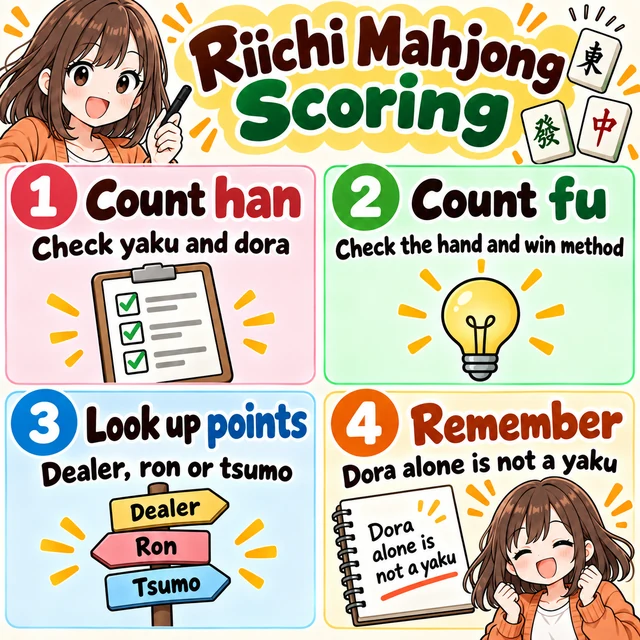 How to Calculate Mahjong Scores
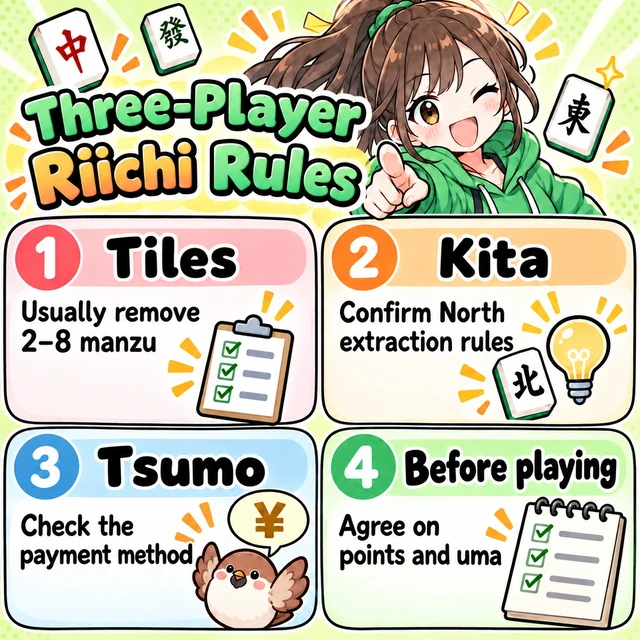 Three-Player Mahjong Rules
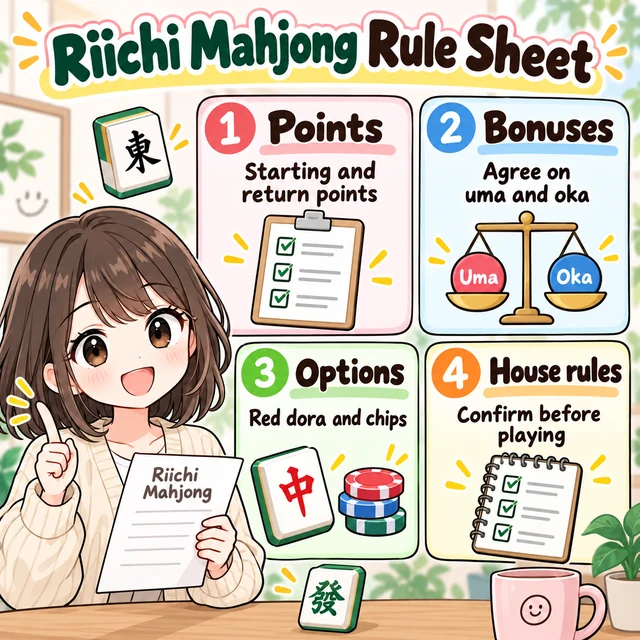 Mahjong House Rules Template
 Riichi Mahjong Yaku List