


Start here
Agree on the rules
before you play.
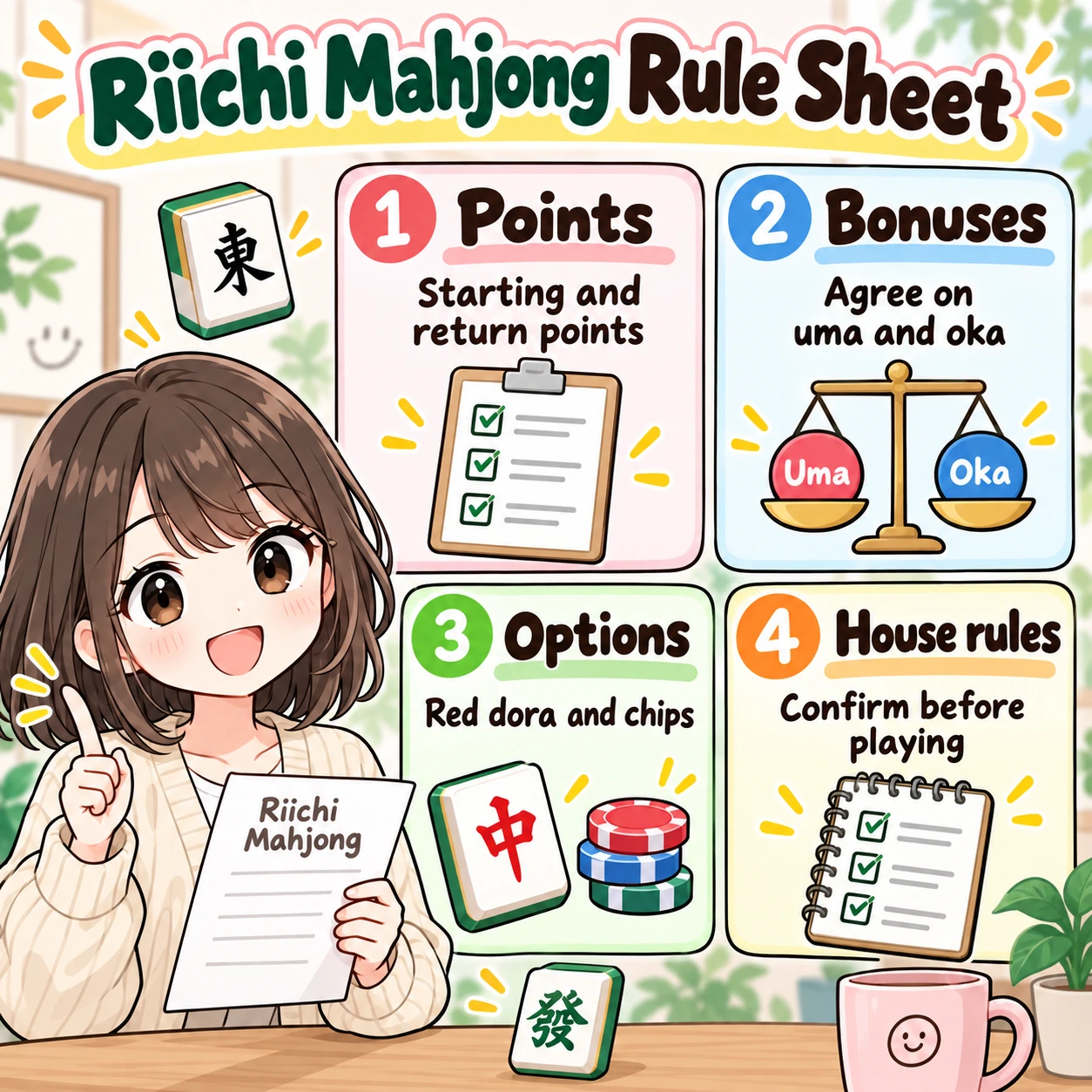
Put everything from starting points to settlement on one sheet. Check it together before the first deal.
Three things to remember
- Starting and return pointsSet the starting score and settlement baseline
- Uma and okaConfirm placement adjustments and the winner’s bonus
- Red fives, bankruptcy and moreMake sure everyone knows the house rules
 Enlarge the illustration ↗
1. Download and fill in the rules sheet
Mahjong House Rules Template
A rules checklist for four-player mahjong and sanma
Write the settings everyone has agreed on in the “Our settings” column. A simple yes or no can be ambiguous: specify point values, tile counts, conditions and payment methods.
| Category | Rule | Our settings | What to confirm |
|---|---|---|---|
| Format | Four-player / three-player | Number of players | |
| Format | East-only / East–South | Game length | |
| Points | Starting points | Each player’s starting score | |
| Points | Return points | Settlement baseline | |
| Settlement | Uma | Placement adjustments | |
| Settlement | Oka | Winner’s bonus | |
| Settlement | Tied placements | Initial seat order, sharing adjustments, etc. | |
| Tiles | Red fives | Suits and number of tiles | |
| Yaku | Open tanyao (kuitan) | Yes / no | Tanyao after calling |
| Yaku | Atozuke | Yes / no | Yaku determined after an earlier call |
| Scoring | Rounding up to mangan (kiriage) | Yes / no | Cases such as 30 fu, 4 han |
| Yakuman | Counted yakuman (kazoe) | Yes / no | Treatment of 13 han or more |
| Yakuman | Double yakuman | Yes / no | Pure nine gates and similar hands |
| Game flow | Bankruptcy (tobi) | Yes / no | Whether zero or negative points ends the game |
| Game flow | Ending after a dealer win (agari-yame) | Yes / no | The dealer in the final hand |
| Game flow | Ending after dealer tenpai (tenpai-yame) | Yes / no | The dealer in the final hand |
| Game flow | Dealer-repeat conditions | Win / tenpai | |
| Game flow | Honba | Additional payment per honba | |
| Game flow | Multiple ron claims | Double ron / head bump (atamahane) | |
| Game flow | Triple ron | Allow three winners / abortive draw | |
| Game flow | Riichi deposits | Handling deposits when the game ends | |
| Penalties | Chombo | Penalty payment and whether the hand is replayed | |
| Other | Chips | Qualifying conditions, value and payment method |
The minimum rules to agree on before playing
Even when time is short, confirm the player count, game length, starting and return points, uma, oka and red fives. Also prioritize bankruptcy, agari-yame and tenpai-yame because they affect when play ends; double ron and head bump because they change deal-in payments; and chips because they affect the final net result.
| Priority | Item | Why it matters |
|---|---|---|
| Essential | Starting and return points | They determine the starting score and final settlement |
| Essential | Uma and oka | They change the final placement adjustments |
| Essential | Red fives | They affect decisions during play |
| Essential | East-only / East–South | They affect game length |
| High | Bankruptcy and agari-yame | They change when the game ends |
| High | Multiple ron claims | They change what happens after a deal-in |
| High | Chips | They change the final net result |
2. Set scoring and settlement rules
Agree on starting and return points
What are starting points?
Starting points are the score each player receives before play. With a 25,000-point start, everyone begins with 25,000 points.
What are return points?
Return points are the baseline used to calculate raw results after a hanchan. Subtract this baseline from the final score, usually converting each 1,000 table points to one result point.
What does “25,000 start, 30,000 return” mean?
Each player begins with 25,000 points, but final results are measured against 30,000. In four-player mahjong, the difference is 5,000 per player, or 20,000 altogether. This difference becomes the winner’s oka bonus.
Starting points alone do not define settlement
A 25,000-point start with a 25,000-point return has no oka. Always confirm the return points as well as the starting score.
Record starting and return points together
| Starting points | Return points | Effect |
|---|---|---|
| 25,000 points | 30,000 points | Creates an oka of 20 in four-player mahjong |
| 30,000 points | 30,000 points | No oka |
| Other | Other | Specify the difference and how it is settled |
Agree on uma
Uma adjusts results according to placement
Uma is the placement-based adjustment added to or subtracted from each player’s raw result.
What does “10–20 uma” mean?
It commonly means +20 for 1st, +10 for 2nd, −10 for 3rd and −20 for 4th.
What does “10–30 uma” mean?
It commonly means +30 for 1st, +10 for 2nd, −10 for 3rd and −30 for 4th. Compared with 10–20, both the first-place bonus and last-place deduction are larger.
Write down all four placement adjustments
| Placement | Uma |
|---|---|
| 1st | +30 |
| 2nd | +10 |
| 3rd | -10 |
| 4th | -30 |
Check that the uma adjustments total zero
In this example, +30 + 10 − 10 − 30 = 0. Writing out every placement makes input errors easier to spot.
Agree on oka
What is oka?
Oka is the winner’s bonus created by the difference between starting and return points.
How much oka does a 25,000 start and 30,000 return create?
(30,000 − 25,000 points) × 4 players = 20,000 points
With 1,000 table points equal to one result point, the oka is 20, normally awarded to first place.
Oka and uma are separate adjustments
With oka 20 and uma 10–20, first place receives +20 oka and +20 uma in addition to the raw result.
A 30,000 start and 30,000 return produces no oka
When starting and return points are equal, the difference is zero.
| Item | Uma | Oka |
|---|---|---|
| Basis | Final placement | Starting and return points |
| Who it applies to | Every placement | Usually first place |
| Purpose | Reward higher placements | Settle the gap between starting and return points |
If chips are used, specify all these details
Agree on each chip’s value, which events award them (such as red fives, ippatsu or ura-dora), whether the hand must be closed, and who pays on ron or tsumo. Recording chips separately from table-point results makes the final breakdown clearer.
| Item | Setting |
|---|---|
| Chips | Yes / no |
| Value per chip | Money or result points |
| Red fives, ippatsu and ura-dora | Qualifying events and conditions |
| Other | Yakuman, North extraction, etc. |
| On ron | Payment by the discarder |
| On tsumo | Payment by each opponent |
Try MemoJong: Save your agreed rules in the app →
3. Agree on tiles, yaku and limit hands
Set red-five and dora rules
“Red fives: yes or no” is not specific enough
The suits and number of red fives affect hand values and push–fold decisions.
Specify how many red 5-man, 5-pin and 5-sou tiles are used
| Tiles | Count |
|---|---|
| Red 5-man | 1 tile |
| Red 5-pin | 1 tile |
| Red 5-sou | 1 tile |
| Total | 3 tiles |
Do red fives count as dora?
They usually count as dora. Whether they also award chips is a separate rule.
Ura-dora
Agree on whether a player who wins after riichi checks the ura-dora indicators.
Kan-dora
Confirm whether a kan reveals a new dora indicator and exactly when it is revealed.
Kan ura-dora
When a player wins after riichi, decide whether to check kan ura-dora as well.
Yaku rules: open tanyao, atozuke and more
Open tanyao: allowed or not
Allowing open tanyao means a hand with tanyao may win even after chi or pon.
Atozuke: allowed or not
Agree on whether a yaku may become established only after an earlier call or on the winning tile. Follow the specific interpretation in your chosen rules.
Formal tenpai (keiten)
Check whether a hand with no legal winning tile can still count as tenpai at a draw.
Nagashi mangan
Define the conditions and whether it is treated as a win or a drawn hand.
Renhou
If allowed, specify its value: mangan, baiman, yakuman or another agreed value.
Are local yaku allowed?
Make sure everyone knows each yaku’s name, required shape and value.
| Item | Setting |
|---|---|
| Open tanyao (kuitan) | Yes / no |
| Atozuke | Yes / no |
| Formal tenpai (keiten) | Yes / no |
| Nagashi mangan | Yes / no |
| Renhou | Specify the hand value too |
| Local yaku | Name, conditions and value |
Kiriage mangan, counted yakuman and double yakuman
What is kiriage mangan?
This rule rounds scores just below mangan up to mangan.
Does 30 fu, 4 han round up to mangan?
Normally the ron scores are 7,700 for a non-dealer and 11,600 for the dealer. With kiriage, they become 8,000 and 12,000.
Does 60 fu, 3 han round up to mangan?
It has the same basic points as 30 fu, 4 han, so apply the same treatment.
Is counted yakuman allowed?
Decide whether 13 han or more counts as yakuman or is capped at sanbaiman.
Are double yakuman allowed?
Confirm the treatment of hands such as suuankou tanki and pure nine gates (junsei chuuren poutou).
Can multiple yakuman be combined?
Also agree on stacking yakuman and whether liability payments (pao) apply.
| Item | Setting |
|---|---|
| Rounding up to mangan (kiriage) | Yes / no |
| Counted yakuman (kazoe) | Yes / no |
| Double yakuman | Yes / no |
| Stacked yakuman | Yes / no |
| Liability payment (pao) | Yes / no |
4. Set game flow, end conditions and penalties
Agree on bankruptcy and game-ending conditions
Bankruptcy: enabled or disabled
With bankruptcy enabled, the game ends when a player’s score falls below the agreed threshold.
Does exactly zero end the game, or only a negative score?
“Zero or less” and “less than zero” are different. State explicitly whether exactly zero ends the game.
Can play continue with a negative score?
If bankruptcy is disabled, agree on how negative scores will be recorded.
Will the game extend into South or West?
Define extension conditions if nobody has reached the target score after the scheduled final hand.
State the end condition explicitly
Example: the hanchan ends as soon as a player’s score falls below zero.
Agree on agari-yame and tenpai-yame
What is agari-yame?
It allows the dealer in the final hand to end the game after winning, provided the specified placement condition is met.
What is tenpai-yame?
It allows the final dealer to end the game after a drawn hand while in tenpai, provided the specified conditions are met.
Can the final dealer stop while in first place?
Decide whether stopping is allowed only in first place or at other placements too.
Is stopping optional or automatic?
Specify whether the dealer chooses or the game ends automatically when the conditions are met.
Do some rules allow stopping below first place?
Yes, some tables do. Write down the exact placement requirement.
Example: a final-hand dealer who wins while in first place may choose to end the game.
Agree on dealer repeats and honba
Dealer repeat after a win
Confirm whether the dealer retains the seat after winning.
Does dealer tenpai also cause a repeat?
Decide whether the dealer repeats when tenpai at a draw (tenpai renchan), or only after a dealer win (agari renchan).
Does the dealership pass when the dealer is noten?
Note any exceptions that apply only in particular hands.
How much is one honba worth?
Four-player games often use 300 points per honba, but rules vary.
Honba payments on tsumo
At 300 points per honba, each opponent normally pays an extra 100 points.
| Item | Example settings |
|---|---|
| One honba | 300 points |
| Ron | The discarder pays an extra 300 points |
| Tsumo | Each opponent pays an extra 100 points |
Agree on double ron, head bump and triple ron
What is double ron?
It allows two players to win by ron on the same discard.
What is head bump (atamahane)?
Only the claimant nearest to the discarder in counterclockwise turn order wins.
Is triple ron allowed?
Decide whether all three ron claims on one discard can win.
Does triple ron cause an abortive draw?
Some rules make three simultaneous ron claims an abortive draw (sanchahou) instead of awarding three wins.
Who receives riichi deposits and honba payments?
For multiple winners, specify how both deposits and honba payments are allocated.
| Item | Setting |
|---|---|
| Double ron | Yes / no |
| Head bump (atamahane) | Yes / no |
| Triple ron | Yes / no |
| Triple-ron draw (sanchahou) | Abortive draw: yes / no |
| Allocation of riichi deposits | Recipient and any sharing method |
Agree on riichi sticks and deposits
Riichi deposits go to a winner
Normally, the next winner collects the riichi deposits on the table.
Who collects them after double ron?
Specify priority by position or head-bump order, or an agreed sharing method.
What if deposits remain when the hanchan ends?
If the game ends in a draw, establish who receives the remaining deposits before settlement.
First place receives them, or they carry over?
If deposits carry over to the next hanchan, make sure everyone knows.
Agree on tied placements
Methods for resolving ties
Some rules assign different placements by seat order even when final scores are equal.
Priority to the player closest to the initial dealer
Resolve the tie using the initial dealer and the original seat order.
Sharing placement adjustments
Add the uma for the occupied placements and divide equally among the tied players.
Recording an exact tie
If ties remain in the record, use a consistent method for calculating average placement.
Confirm tie handling before settlement
Write the rule down before playing, rather than choosing after seeing the result.
Agree on chombo and other penalties
Which mistakes count as chombo?
Specify covered errors, such as invalid ron, invalid tsumo or declaring riichi without tenpai.
Invalid ron or tsumo
Some rules distinguish an incorrect spoken declaration from one followed by revealing the hand.
Riichi without tenpai
Define the penalty when this is discovered at a drawn hand.
Too many or too few tiles
Agree whether this makes the hand dead or incurs chombo.
Disturbing the wall
Define what can be restored and when damage makes the hand impossible to continue.
Chombo payments
Specify the penalty, such as a mangan payment or a fixed deduction in result points.
Does the dealer change, or is the hand replayed?
Also specify what happens to honba, riichi deposits and the dealer’s turn.
| Item | Setting |
|---|---|
| Invalid ron or tsumo | Spoken declaration / revealed hand |
| Riichi without tenpai | Penalties |
| Too many or too few tiles | Dead hand, chombo or another penalty |
| Penalty | Points paid |
| What happens to the hand | Dealer, honba and riichi deposits |
5. Add sanma-specific rules
Three-player mahjong needs additional agreements
Sanma rules vary even more widely than four-player rules. Record the main settings rather than simply labeling the game “sanma.”
Tiles used
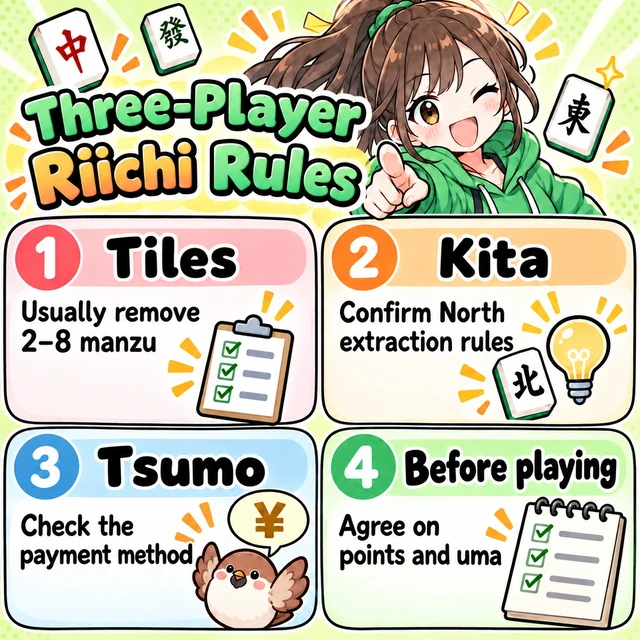
Check whether 2–8 manzu are removed and whether flowers or other tiles are added.
Are 2–8 manzu removed?
Removed tiles are not used in play, which also determines whether red 5-man can be included.
North extraction (nuki)
Decide whether a player may extract North from the hand and draw a replacement tile.
Does extracted North count as nuki dora?
Confirm whether extracted North tiles count as dora or award chips.
Can North remain in the hand?
Decide whether North may be kept as part of a triplet or pair instead of extracted.
Does North count as yakuhai?
Depending on the rules, North may be a value wind for everyone, a particular seat wind, or a non-value wind.
Tsumo loss or compensated payments?
Decide whether to compensate for the payment that the missing fourth player would have made.
Is chi allowed?
Sanma commonly prohibits chi, but always check.
Number of red fives
Because the tile set differs, the number of red fives may differ from four-player games.
Sanma-specific yaku
List any additional yaku and their han or point values.
Honba payments
State who pays how much on ron and on tsumo.
Scoring method
Share the specific scoring table, including the treatment of tsumo loss.
| Item | Our settings |
|---|---|
| Starting and return points | |
| Tiles used | |
| North extraction and North’s role | |
| Tsumo loss | Yes / no |
| Chi | Yes / no |
| Red fives | |
| Uma and oka | |
| Bankruptcy and agari-yame | |
| Honba and other settings |
Also see Three-Player Mahjong Rules and Tracking Three-Player Mahjong Results.
6. Example settings and a final checklist
Example rules for a four-player game
A starting point for games with friends
| Item | Example settings |
|---|---|
| Format | East–South game |
| Starting and return points | 25,000 starting points / 30,000 return points |
| Uma and oka | Uma +20 / +10 / −10 / −20; oka 20 |
| Red fives | One red five in each suit |
| Open tanyao and atozuke | Allowed |
| Bankruptcy (tobi) | Enabled (below zero) |
| Agari-yame and tenpai-yame | Allowed |
| Double ron | Allowed |
| Triple ron | Triple-ron draw (sanchahou) |
| Honba | 300 points |
| Chips | Disabled |
This is one example, not a universal four-player standard.
Example rules for a sanma game
A starting point for three-player play
| Item | Example settings |
|---|---|
| Format | East–South game |
| Starting and return points | 35,000 starting points / 40,000 return points |
| Tiles used | Remove 2–8 manzu |
| North extraction (nuki) | Allowed; counts as nuki dora |
| Tsumo loss | Disabled |
| Chi | Disabled |
| Red fives | One red 5-pin and one red 5-sou |
| Uma | +20 / 0 / −20 |
| Bankruptcy (tobi) | Enabled (below zero) |
| Ending after a dealer win (agari-yame) | Allowed |
| Honba | Follow the chosen scoring table |
| Chips | Disabled |
Do not assume these are universal defaults
The table above is only a suggested setup. Starting points, uma, North and tsumo payments vary considerably between tables.
Check the app, venue or local rules
Online services may use different rules in different modes, so record both the service and the mode.
M.League: an example ruleset
M.League starts at 25,000 and uses a 30,000-point baseline
Under M.League’s official rules, each player starts with 25,000 points. At the end of the hanchan, the amount above 30,000 is positive and any shortfall is negative.
Placement adjustments: +50 / +10 / −10 / −30
The adjustments are +50,000 for 1st, +10,000 for 2nd, −10,000 for 3rd and −30,000 for 4th. These and the table-point results are converted at 1,000 points to one result point.
| Item | Setting |
|---|---|
| Format | East–South game |
| Starting points | 25,000 points |
| Settlement baseline | 30,000 points |
| Placement adjustments | +50 / +10 / −10 / −30 |
| Conversion | 1,000 table points = 1 result point |
Differences from casual house rules
M.League has a larger first-place adjustment and specific rules such as sharing placement adjustments between tied players.
“M.League rules” may not be specific enough
If your group changes red-five or bankruptcy rules, record those differences explicitly.
Saikouisen: an example ruleset
Each player starts with 30,000 points
Saikouisen rules use a 30,000-point start and 30,000-point return, with no oka.
Placement adjustments: +30 / +10 / −10 / −30
The 10,000/30,000-point uma corresponds to +30 for 1st, +10 for 2nd, −10 for 3rd and −30 for 4th.
| Item | M.League | Saikouisen |
|---|---|---|
| Starting points | 25,000 points | 30,000 points |
| Settlement baseline | 30,000 points | 30,000 points |
| Placement adjustments | +50 / +10 / −10 / −30 | +30 / +10 / −10 / −30 |
Comparing Saikouisen and M.League
Both are four-player formats, but their starting points and first-place adjustments differ. Saikouisen Classic is a separate ruleset, so check the exact name as well.
A 30-second pre-game checklist
Four-player mahjong
- Three or four players / East-only or East–South
- Starting and return points / uma and oka
- Red fives / open tanyao / atozuke
- Bankruptcy / agari-yame / tenpai-yame
- Honba / double ron or head bump / triple ron
- Ties / chips / chombo
Additional checks for sanma
- Tile set / North extraction / North’s role
- Tsumo loss / chi / sanma-specific yaku and scoring
Game details to save with your rules sheet
| Item | Why record it |
|---|---|
| Date and players | Check the game later |
| Four-player / three-player | Keep different formats separate |
| East-only / East–South | Analyze each set of conditions separately |
| Ruleset used | Compare results under the same conditions |
| Placement and final table score | Calculate average placement and raw results |
| Final result points | Track overall results |
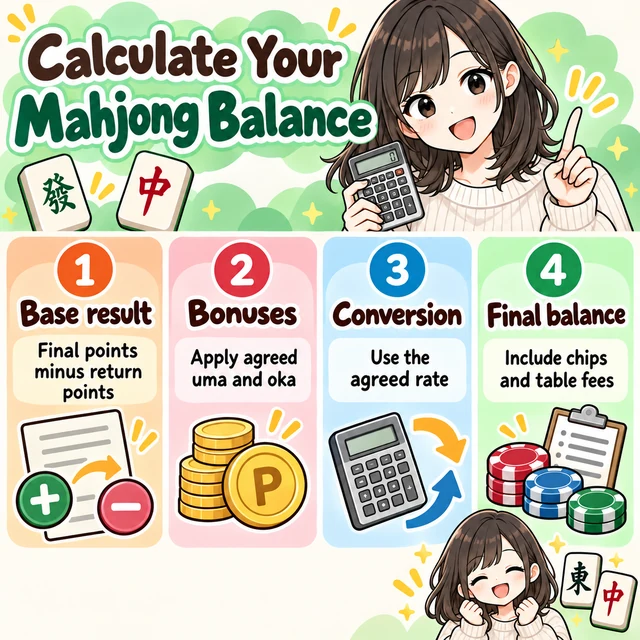
| Chips and table fees | Understand the final net result |
Sources
- M.League official rules: starting points, settlement baseline and placement adjustments (accessed August 27, 2026).
- Saikouisen rules and overview: starting points, return points and uma (accessed August 27, 2026).
Published rules may change. Check the latest version before playing.
 Three-Player Mahjong Rules
 Four-Player and Sanma Scoring Tables
 Calculating Mahjong Net Results
 Average Placement in Mahjong