


Start here
For sanma,
start with the table rules.
Review the tiles, North rules and tsumo payments, including differences from four-player mahjong and settings that vary by table.
Three things to remember
- Tiles and NorthCheck 2–8 characters and extraction dora
- Tsumo paymentsAgree whether tsumo loss applies
- Starting points and umaSet starting scores and placement bonuses
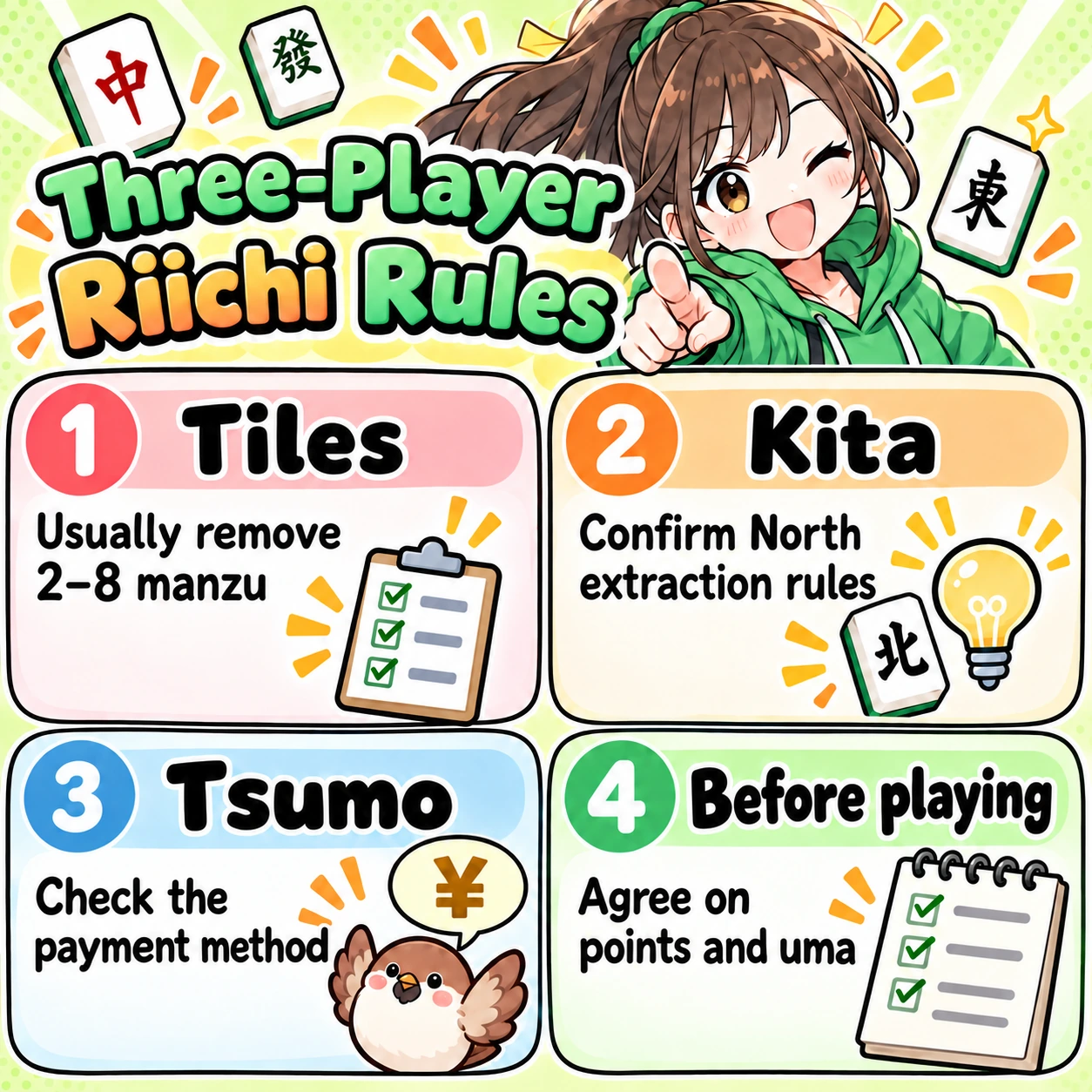 Enlarge the illustration ↗
1. Tiles and differences from four-player mahjong
| Item | Four-player mahjong | Common three-player settings |
|---|---|---|
| Players | 4 players | 3 players |
| Seats | East, South, West, North | East, South, West |
| Tiles used | 136 tiles | Typically 108 tiles, removing 2–8 characters |
| Chi | Allowed | Usually not allowed |
| Pon and kan | Allowed | Allowed |
| North | Can be North seat's value wind | Extraction dora, value honor for everyone, etc. |
| Tsumo | Receives payment from three players | Receives payment from two players |
| Tsumo loss | Usually not relevant | Total received depends on whether it applies |
| Placement | 1st–4th | 1st–3rd |
| Average-placement baseline | 2.50 | 2.00 |
| Uma | For four players | For three players |
How does sanma differ from four-player mahjong?
Sanma has East, South and West seats, with no North-seat player. Common rules remove 2–8 characters and prohibit chii, so both the tile set and calling options differ. Tsumo has two payers instead of three, requiring a decision about tsumo loss.
The table above shows common examples, not universal rules. Sanma varies by venue, service, region and group. At minimum, agree on North, tsumo loss, starting and return points, uma, oka, honba, bankruptcy and multiple wins before playing.
Which tiles does sanma use?
Four-player mahjong uses four copies of 34 tile types, totaling 136. Common sanma removes four copies each of 2–8 characters: 28 tiles, leaving 136 − 28 = 108 tiles. The 1 and 9 characters remain, along with all circles, bamboo and honors.









| Type | Use in common sanma |
|---|---|
| 1-man | ○ |
| 2–8 characters | × |
| 9-man | ○ |
| 1–9 circles | ○ |
| 1–9 bamboo | ○ |
| East, South, West, North; white, green and red dragons | ○ |
Fewer tile types make hands easier to assemble, with more opportunities for half flushes, full flushes and honor-based hands. North extraction dora can raise scores further, and games often develop faster than four-player mahjong.
Is chii prohibited in sanma?
No chii is the common convention. Chii uses the left-hand player's discard to make a sequence, but is often prohibited in sanma, so sequences are generally built by self-draw. Pon and kan are usually allowed.
| Open hand | Common sanma treatment |
|---|---|
| Chi | Disabled |
| Pon | Allowed |
| Called kan, added kan and concealed kan | Allowed |
Removing chii limits calling opportunities and can help balance a reduced tile set. However, sanma with chii also exists. Do not assume all sanma prohibits chii; check the rules being used.
2. North extraction, value honors and tsumo loss
The key sanma question: how does North work?
With no North-seat player, North needs a separate rule. Common options are extraction dora, where it is exposed and removed from the hand; a value honor for all three players; or an ordinary wind tile.

| North treatment | Details |
|---|---|
| Extraction dora (kita/nuki-dora) | Remove it from the hand and count it as dora |
| Shared value honor | A value honor for all three players |
| Ordinary wind | Treat it as a normal honor tile |
| Special dora | Value determined by table-specific conditions |
A common North-extraction method exposes North, removes it from the hand and draws a replacement tile. Each extracted North often counts as one dora; under such rules, four extracted Norths give four dora.
Details vary: when North may be extracted, whether it may stay in the hand, whether a retained North is yakuhai, whether it can be called for pon or kan, whether it can be used in thirteen orphans, whether a replacement win is rinshan, and whether an extracted North can be ronned. Confirm each rather than merely saying “North extraction allowed.”
| Rule | Example settings |
|---|---|
| North extraction (nuki) | Yes / no |
| Extracted North | One dora per tile |
| Use in the hand | Allowed / Not allowed |
| North retained in the hand | Shared value honor / Ordinary wind |
| Pon and kan | Allowed / Not allowed |
| Kokushi musō (thirteen orphans) | For example, allowed in the hand |
| Win immediately after extraction | Rinshan / Ordinary tsumo |
| Ron on extracted North | Allowed / Not allowed |
North extraction and North yakuhai are separate rules
Extracting North and treating North as yakuhai are separate settings. A ruleset may allow extraction without making retained North a value honor. Another may prohibit extraction and make North yakuhai for everyone.
SEGA MJ sanma is an example where North is a shared value honor rather than extraction dora. Sanma does not always require extracting North. A vague phrase such as “North allowed” is insufficient: specify extraction, use in the hand and yaku status separately.
What is tsumo loss?
In four-player mahjong, a non-dealer mangan tsumo collects 4,000 from the dealer and 2,000 from each other non-dealer, totaling 8,000. Sanma has no North-seat player, so applying the same shares leaves one payer missing.
Non-dealer mangan tsumo in four-player mahjong
Dealer 4,000 + Non-dealer 2,000 + Non-dealer 2,000 = 8,000 total
The tsumo-loss rule decides whether to leave that missing share unpaid or redistribute it between the remaining two opponents. This is a frequent source of sanma scoring errors, so confirm it before play.
Tsumo loss versus no tsumo loss
With tsumo loss, nobody compensates for the absent North player's share. A non-dealer mangan tsumo collects 4,000 from the dealer and 2,000 from the other player, totaling 6,000 rather than the 8,000 ron value.
With no tsumo loss, the missing share is added to the remaining two payments so the winner receives the full 8,000 mangan total. Several ways of dividing that amount exist.
| Method | Dealer pays | Non-dealer pays | Total received |
|---|---|---|---|
| With tsumo loss | 4,000 | 2,000 | 6,000 |
| Example: redistribute the absent player's share | 5,000 | 3,000 | 8,000 |
| Example: equal payments | 4,000 | 4,000 | 8,000 |
Dealer tsumo and hands below mangan also vary with the method and rounding rule. Specify the dealer/non-dealer split and rounding to 100 points, rather than only saying “no tsumo loss.” The changed value of tsumo can affect riichi and push-or-fold decisions.
Does sanma scoring differ from four-player scoring?
The use of yaku, han and fu to obtain basic points, and often ron values, is shared with four-player mahjong. Tsumo is the main difference: tsumo loss, equal payments and rounding affect each player's share.
North-extraction dora and many red tiles can also produce higher-value hands. Use the table's sanma tsumo chart rather than settling everything from a four-player chart. See the four-player and three-player score tables for examples.
Try it in MemoJong: Start recording with your agreed sanma rules →
3. Starting points, uma, oka and honba
How many points does sanma start with?
Sanma has no universal starting score. Settings include 25,000, 30,000, 35,000 and 40,000. Although 35,000 is common, it is not a standard shared by every ruleset.
Higher starting points make bankruptcy less likely for the same loss and change final-round placement conditions. Online services and modes vary, so check the game screen or official rules.
What are return points in sanma?
Starting points are the initial score; return points are the settlement baseline. With 35,000 starting and 40,000 return points, calculate each player's raw result relative to 40,000.
If the difference is settled as oka, the 5,000-point gap across three players totals 15,000 points. At 1,000 table points per result point, the oka is 15 result points.
(40,000 − 35,000) × 3 players = 15,000 table points = 15 result points
Some sanma uses equal starting and return points with no oka. Always record the two settings together.
How should sanma uma be set?
Set uma for all three places: first, second and third. A zero-sum allocation, whose total is zero, is easy to check.
| Placement | Uma example |
|---|---|
| 1st | +20 |
| 2nd | 0 |
| 3rd | -20 |
| Total | 0 |
Options include +30 / 0 / −30 and allocations that also make second place negative. Do not reuse a four-player shorthand such as “10–20”; specify all three values. Larger uma increases placement's importance relative to raw scores.
What is sanma oka?
Oka is a settlement adjustment arising from the gap between starting and return points. In sanma, the difference across three players is often awarded entirely to first place.
With 35,000 starting and 40,000 return points, oka is 15 result points. There may be no oka if the values are equal or the difference is handled another way. See mahjong net-result calculation for the full process.
How much is one honba in sanma?
A common four-player honba is 300 points, while sanma settings vary, including 600 or 1,000. Add honba after calculating the ordinary winning score.
Also specify whether the ron discarder pays the entire honba and how tsumo splits it between two players. Tsumo-loss and honba-sharing methods may be independent, so state the payment allocation as well as the total.
Sanma noten payments
At an exhaustive draw, noten payments transfer points from players not in tenpai to those in tenpai. Rules may use a 3,000-point pool, a 2,000-point pool or no payment.
With a 3,000-point pool, one tenpai player might receive 1,500 from each noten player; with two in tenpai, the one noten player pays 1,500 to each. Follow the rules for the actual split. Check this alongside draw handling and dealer repeats on tenpai.
4. Dealer repeats, game endings and multiple ron
Dealer-repeat rules in sanma
Under win-based repeats (agari renchan), the dealer repeats only after winning. Under tenpai repeats (tenpai renchan), the dealer also repeats when in tenpai at an exhaustive draw. A noten dealer usually passes the seat, though exceptions exist.
For the final round, check agari-yame, allowing a leading dealer to end after a win, and tenpai-yame, allowing an end after a draw while leading and in tenpai. Whether ending is optional or automatic also affects strategy.
Bankruptcy (tobi) rules
Bankruptcy ends the game when a score reaches a defined threshold. Rules may end below zero, at zero, or have no bankruptcy ending.
Some award a bonus to the player causing bankruptcy or include negative scores in settlement. Starting with 25,000 versus 35,000 also changes bankruptcy risk. Confirm starting points, ending thresholds, bankruptcy bonuses and negative-score settlement together.
Double ron or head-bump priority?
In sanma, both opponents can claim ron on the same discard. Double ron recognizes both wins; head-bump priority (atamahane) awards the win only to the claimant nearest in turn order after the discarder.
Agree who receives riichi deposits and honba, whether both wins are paid if one bankrupts the discarder, and how the dealer-repeat decision works. This prevents disputes when double ron occurs.
Abortive draws in sanma
Check abortive-draw rules such as nine terminals and honors or four kans. Four identical opening winds cannot apply unchanged without a North-seat player and is usually omitted. Triple ron also cannot occur with only three players total.
Some sanma rules reduce the number of abortive-draw conditions. Specify whether the dealer repeats and what happens to honba and deposits, rather than listing only the draw names.
5. Red dora, chips and service-specific rules
Local rules for red dora, gold tiles and chips
Sanma may use red fives of circles and bamboo, gold tiles, flowers, North-extraction chips, ippatsu or ura-dora chips, and yakuman bonuses. If 2–8 characters are removed, there is no 5 of characters, so no red 5 of characters can be used.
Chips are settled separately from game points and can substantially affect net balances. Define eligible tiles, closed-hand restrictions, payers on ron and tsumo, and the value of each chip.
Special rules sometimes used in sanma
Examples include making every 5 of circles and bamboo red, awarding chips for each North extraction, extending into another East or South round if no player reaches a threshold, settling negative scores, and adding yakitori or bankruptcy bonuses.
Counted yakuman, double yakuman, renhō and nagashi mangan also vary by table. Write each special rule on the rule sheet instead of relying on “our usual sanma rules.”
Online sanma rules differ by service
Online mahjong has no single shared sanma ruleset. Conditions can vary by service and by mode, including East-only, hanchan, tournament and ranked games.
SEGA MJ's official rules remove 2–8 characters, prohibit chii and make North a value honor for all players, with no North extraction. The absent North player's tsumo share is split between the remaining two and rounded up. Starting/return points are 35,000/40,000, uma is +20 / 0 / −20, and dealer repeats are win-based.
By contrast, Mahjong Fight Club's published rules specify a 25,000-point start, no chii, equal tsumo payments regardless of dealer status, 600-point honba and placement points of +3 / 0 / −3. Check the rules whenever you change games; both are sanma, but the settings differ.
6. Pre-game checklist and record keeping
A sanma rule statement you can read aloud before playing
Putting the settings into one continuous statement makes omissions easier to spot.
“We remove 2–8 characters. No chii. North can be extracted as dora or used in the hand; retained North is yakuhai for everyone. Tsumo loss applies. Start at 35,000 and return at 40,000, with uma +20 / 0 / −20. Honba is 1,000 points and the noten pool is 3,000. The dealer repeats on a win. Double ron is allowed, and bankruptcy occurs below zero.”
Complete pre-game sanma checklist
Tiles and calls
Tile set, 2–8 characters, chii, red dora and gold tiles.
North
North extraction, dora value, use in hand, yakuhai status, pon/kan, rinshan after extraction, ron on extracted North, and thirteen-orphans treatment.
Points
Tsumo loss, payment method, rounding, honba and noten payments.
Settlement
Starting points, return points, uma, oka, negative-score settlement and chips.
Game flow
Win-based or tenpai repeats, bankruptcy, agari-yame, tenpai-yame and extra East/South rounds.
Wins and draws
Double ron, head-bump priority, deposits, abortive draws, counted yakuman, double yakuman, nagashi mangan and renhō.
Track sanma results separately from four-player results
Sanma differs in starting points, uma, tsumo-loss rules and chip conditions. Combining all monetary balances can hide which format performs better and which rules affect the result.
Ideally, separate four-player and three-player games, and also separate sanma groups with substantially different rules. See sanma results and balance tracking and mahjong net-result calculation for settlement methods.
In sanma, last-place rate means the proportion of third-place finishes. Keep it separate from four-player fourth-place rate.
Rules and references consulted
- SEGA MJ sanma rules: tiles, North, chii, tsumo payments, starting/return points, uma and dealer repeats (accessed August 27, 2026)
- Mahjong Fight Club three-player rules: starting points, placement points, tiles, equal payments, honba and bankruptcy (accessed August 27, 2026)
- Japan Professional Mahjong League: Three-player mahjong: equal payments and the no-chii approach (accessed August 27, 2026)
Settings attributed to specific services are examples of those services' rules, not universal sanma standards.
Related guides
 Four-Player and Sanma Scoring TablesRon and tsumo payments at a glance
 Mahjong House Rules TemplatePut your table settings on one sheet
 Sanma results and balance trackingSettle uma, conversion rates and chips
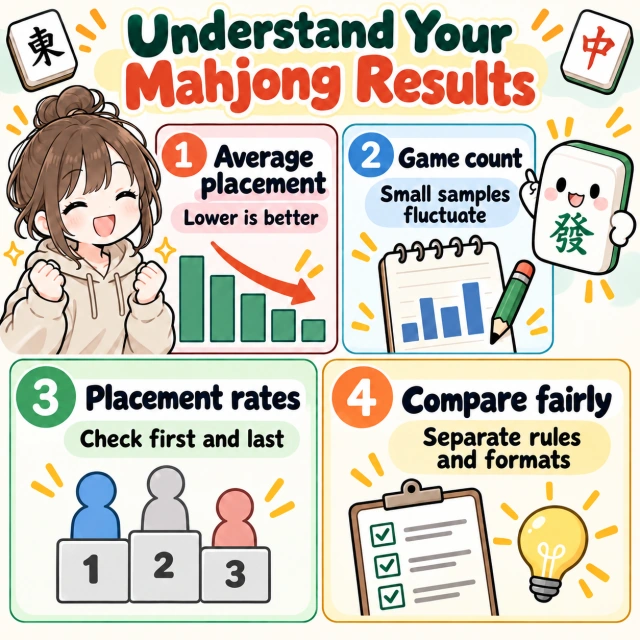 Understanding average placement in mahjongUnderstand the 2.50 four-player and 2.00 sanma baselines
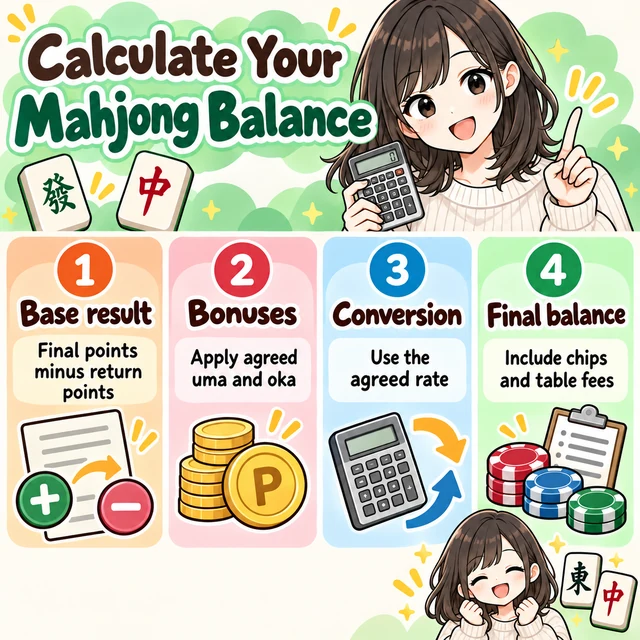 Calculating Mahjong Net ResultsReview uma, oka and conversion rates